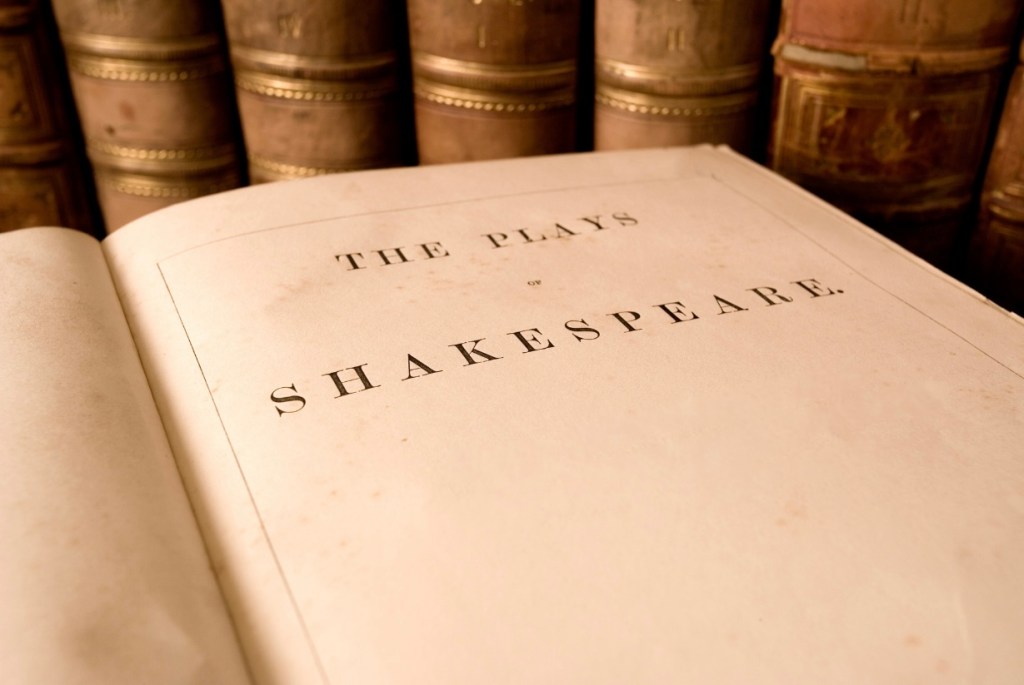
William Shakespeare was an English playwright and poet, known today all around the Globe….(get it?)
Amongst his many sonnets, Shakespeare wrote a number of plays in the following genres: comedy, history and tragedy. Of these three, Macbeth is considered a tragedy.
So, what makes a tragedy play?
A tragedy play is a play that deals with tragic events and an unhappy ending, especially involving the downfall of the main character.
What does Shakespeare often include in his tragedy plays?
Well, he often explores the darkest depths of human nature – betrayals, suicides, murder- you name it. These plays often follow a sobre tone, with many flawed characters, and the protagonist often has a defined downfall (also known as hamartia). Most notable, a Shakespearean tragedy will include a death of some sort.
Fun fact: Shakespearean comedies cannot end in death, and often end in a marriage instead. This is why his play ‘Measure for Measure’ (which, as the name suggests, bounces between comedy and tragedy) only involves a faked death and ends with an ambiguous marriage proposal!
When trying to identify a Shakespearean tragedy play, look out for the following:
- A tragic hero with an inevitable downfall
- The exploration of good vs evil
- Tragic waste
- Conflict
- Supernatural
Tragic Hero
Macbeth can definitely be considered a tragic hero. For a start (spoiler alert), the play ends with his death. It can be argued that his death is due to his uncontrollable greed to be king. His greed was his fatal flaw. Macbeth was an honoured solider, loved by King Duncan before his interaction with the three witches. Without his greed, Macbeth may have lived a long and successful life.
Additionally, despite his predestined fate, the three witches did not instruct Macbeth to kill Duncan, Banquo or the Macduff family. His over-ambition and greed is to blame for his ultimate hamartia. However, with all of this in mind, can Macbeth even be considered a ‘hero’ at all? Can he be pitied for his actions?
The Exploration Of Good Vs Evil
Many essays could be (and have been) written about the exploration of good vs evil within ‘Macbeth’. We see this throughout the play; most explicitly, the juxtaposition of Duncan and Macbeth as ‘good’ and well-respected kings. There is also the contrast between the Macbeths’ and Macduffs’ moral compass. More implicitly, we see the struggle between good vs evil through the guilty consciences and eventual descent into insanity of the Macbeths. Specifically, Shakespeare’s frequent use of soliloques is an effective way to show these internal guilty thoughts.
Tragic Waste
Tragic waste is the loss of good along with the bad at the resolution of the play – usually one of ‘good guy’ characters. Examples of tragic waste in ‘Macbeth’ are the deaths of Duncan, Banquo and the Macduff family. You could argue that the loss of Macbeth’s potential as an honourable hero (the Macbeth we saw at the onset of the play) was also a tragic waste.
Conflict
As can be expected of a tragedy, ‘Macbeth’ involves an abundance of conflict. Setting the tone of the entire play, the first act begins as Macbeth and Banquo return from war. This displayed to the audience that Macbeth is not one to shy away from death and gory. Furthermore, the Macbeths are in constant moral conflict with themselves and their destined fate, as well as physical conflict as Macbeth goes against Macduff and Malcom in the final act.
Supernatural
The supernatural is something that is beyond the natural world. This entails magic, witches, ghosts and apparitions – all of which can be found in ‘Macbeth’!
Below are some key supernatural quotes:
- “Fair is foul and foul is fair” (Act 1, Scene 1)
- “Come, you spirits that tend on mortal thoughts, unsex me here, and fill me from the crown to the toe top-full of direst cruelty” (Act 1, Scene 5)
- “Art thou but a dagger of the mind, a false creation?” (Act 2, Scene 1)
- “Thy bones are marrowless, thy blood is cold, thou hast no speculation in those eyes which thou dost glare with” (Act 3, Scene 4)
- ”I am the mistress of your charms” (Act 3, Scene 5)
- “Double, double, toil and trouble, fire burn and cauldron bubble” (Act 4, Scene 1)
With that, while many Shakespeare plays subvert genre conventions, seeing as Shakespeare’s Macbeth checks off all five criteria points for a tragedy play, we can confidently suggest that Macbeth is indeed a tragedy!
Get support for your studies with a private English tutor!
Citations:
Shakespeare, William. Macbeth. Penguin Classics edition, edited by Carol Rutter, Penguin Books LTD, 2015.
 The English Nerd
Leave a comment